GUIDE
Shear angle and locking angle in woven composites
The two numbers behind a draping shear map: what shear angle is, what it does to the laminate, where the locking angle comes from, and what to do when a ply goes past it.
Shear angle
In the undeformed cloth the warp and weft cross at 90°. After draping they cross at some smaller angle, and the shear angle is how far the crossing has closed: 90° minus the angle between the tows. A cell at 0° is a square; at 45° it is a rhombus with a 45° corner; at 90° the tows would be lying on top of each other. DrapeCut reports it without sign, because the cloth does not care which way the rhombus leans.
Shear is not cosmetic. As the crossing closes the same amount of fibre occupies less area, so:
- Areal weight and thickness rise by 1 / cos(shear). At 30° the ply is 15% thicker; at 45° it is 41% thicker; at 60° it has doubled.
- Fibre volume fraction changes locally. In a resin infusion the sheared regions are tighter and harder to wet out; in a wet layup they go resin-rich around them.
- The fibre angle is no longer what the schedule says. A ±45° ply sheared by 15° is a ±30/60° ply there.
- The weave pattern distorts, which matters on a cosmetic part.
Locking angle
Trellis shear is cheap at first: the tows pivot about each other and the only resistance is friction at the crossings. As the angle grows the tows are pushed sideways into their neighbours until they touch, and from then on shearing further means compressing the tows themselves. That transition is the locking angle. Past it the cloth would rather buckle out of plane, and it wrinkles.
The locking angle is a property of the particular cloth: how wide the tows are relative to their spacing, how the weave lets them move, and how the sizing and any binder hold them. A plain weave, with every tow interlaced at every crossing, locks early. A twill, whose tows float over two before going under, locks later. Satins with longer floats go later still. Heavier tows in the same weave lock a little earlier because there is less gap to close. The values are indicative; a picture-frame or bias-extension test on the actual roll is the way to know.
Indicative locking angles
These are the values DrapeCut's weave list uses, with the tow pitch that goes with each. Choosing a weave in the tool sets both.
| Group | Weave | Locking angle | Tow pitch | Areal weight |
|---|---|---|---|---|
| Carbon | Plain 1k · 90 gsm | 28° | 1.0 mm | 90 gsm |
| Carbon | Plain 3k · 200 gsm | 30° | 2.0 mm | 200 gsm |
| Carbon | 2×2 twill 3k · 200 gsm | 45° | 2.0 mm | 200 gsm |
| Carbon | 2×2 twill 6k · 400 gsm | 44° | 3.0 mm | 400 gsm |
| Carbon | 2×2 twill 12k · 600 gsm | 42° | 4.5 mm | 600 gsm |
| Carbon | 4H satin 3k · 285 gsm | 48° | 2.0 mm | 285 gsm |
| Carbon | 5H satin 3k · 285 gsm | 52° | 2.0 mm | 285 gsm |
| Carbon | 8H satin 3k · 375 gsm | 57° | 2.0 mm | 375 gsm |
| Spread tow & heavy | Spread tow plain · 160 gsm | 22° | 12.5 mm | 160 gsm |
| Spread tow & heavy | Plain 12k · 600 gsm | 28° | 5.0 mm | 600 gsm |
| Spread tow & heavy | 2×2 twill 24k · 800 gsm | 40° | 6.0 mm | 800 gsm |
| Glass & aramid | E-glass plain · 300 gsm | 32° | 1.5 mm | 300 gsm |
| Glass & aramid | E-glass 2×2 twill · 300 gsm | 47° | 1.5 mm | 300 gsm |
| Glass & aramid | Aramid plain · 170 gsm | 26° | 1.5 mm | 170 gsm |
| Glass & aramid | Aramid 2×2 twill · 170 gsm | 42° | 1.5 mm | 170 gsm |
| Unidirectional | UD carbon · 150 gsm | 15° | 2.0 mm | 150 gsm |
| Unidirectional | UD carbon · 300 gsm | 15° | 3.0 mm | 300 gsm |
| Unidirectional | UD E-glass · 300 gsm | 15° | 2.0 mm | 300 gsm |
Reading the shear map
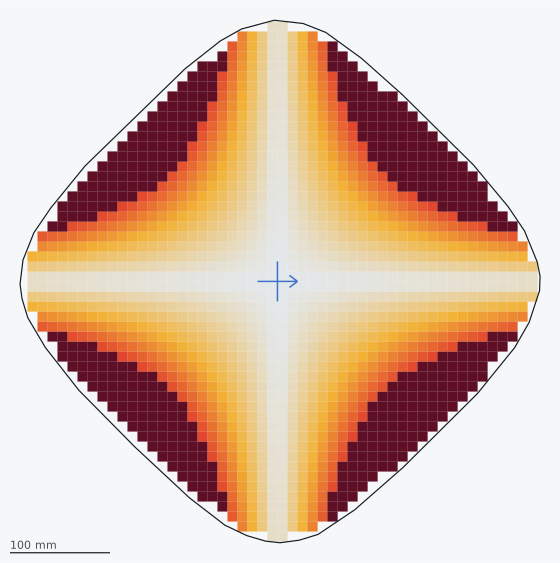
Every cell of the net is coloured by its shear: grey at zero, gold at 55% of the locking angle, red at the locking angle, dark red beyond it. The same colours are painted on the flat pattern so the trouble spots are visible on the template. The panel reports the maximum, the number and percentage of cells past lock, and the coverage.
What to do about cells past lock
- Check where they are. If they fall in the trim allowance, they cost nothing.
- Move the seed or turn the warp. Shear grows with distance from the seed along the diagonals, so re-seeding can move the worst of it onto a part of the surface that is trimmed or hidden.
- Change the weave. A 5H or 8H satin locks 10–15° later than a twill and is the usual answer for a deep draw.
- Dart, split or add a ply. When the geometry needs more shear than any cloth can give, the cloth has to be cut. Cover with pieces lays pieces of the ply from separate seeds and overlaps them.