WORKED EXAMPLE · HALF CYLINDER, 150 MM RADIUS, 400 MM LONG
Composite draping example: cylinder
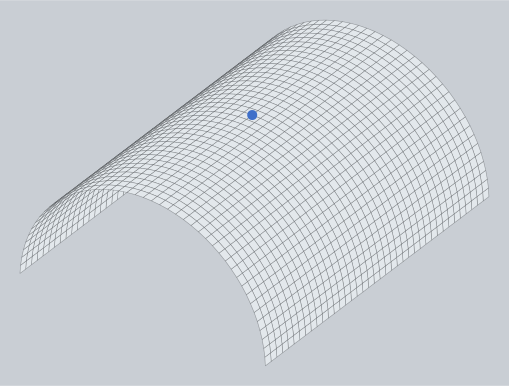
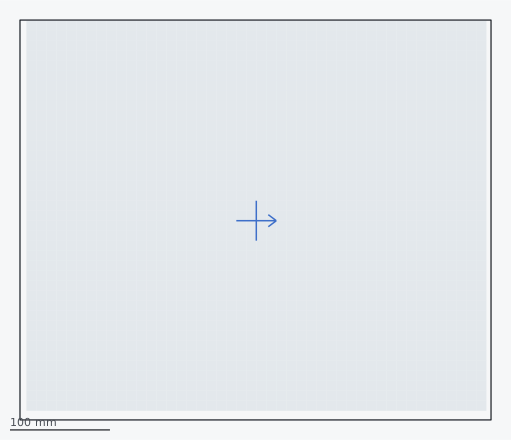
A 2D woven fabric cutting pattern generated from a 3D cylinder using DrapeCut's exact unfolding of a developable surface. Warp at 0°, locking angle 45° (a 2×2 twill), seed placed by the tool. The part is a half cylinder, 150 mm radius, 400 mm long.
What this part shows
The simplest developable surface. Seeded on the crown with the warp along the axis, the net lies down as a rectangle: every tow along the axis is a straight line and every tow across it is an arc of the same length, so the crossings stay square and the flat pattern is exactly the unrolled surface.
Max shear 0° is the numerical floor of the method. A real layup on a cylinder needs no draping simulation at all, but this is the part to test a weave setting or a pitch on before trusting it on a compound curve.
Open this example in DrapeCutChange the seed, the warp angle, the weave or the locking angle and the drape re-solves in well under a second. The DXF for an example downloads without an account.
How this page was made
The sample STL (19602 triangles) was draped by the same solver the tool runs, with these settings:
| Setting | Value |
|---|---|
| Warp direction | 0° |
| Tow pitch | 10 mm (coarse, so the net is legible; real cloth is 1–5 mm) |
| Locking angle | 45° |
| Seed | 0.8, -0.7, 150 mm (suggested by the tool) |
| Cells in the ply | 1794 |
Shear angle is pitch-independent to within the mesh resolution; cloth area and the flat size are quantised to the pitch.