GUIDE
Composite draping software: what it does and when you need it
Draping software predicts how a woven reinforcement conforms to a curved mould: which way the fibres end up pointing, how far the weave shears to get there, and what flat shape the cloth must be cut to. DrapeCut is a browser-based version of the fast kind, free while in beta.
The problem it solves
A woven cloth is not a sheet of rubber. Carbon, glass and aramid tows are stiff along their length, so a cloth cannot stretch to fit a surface; the only freedom it has is for the warp and weft to pivot at their crossings. On a flat panel or a cylinder that never comes up. On anything with double curvature, a dome, a saddle, a wheel arch, a duct, a helmet, the cloth must shear to lie down, and it shears unevenly across the part.
Two things follow. The fibre orientation on the finished part is not what was drawn in the laminate schedule, because the tows have rotated. And the flat shape that lands on the mould without bunching is not the flattened CAD surface, because the cloth deforms by shear rather than by stretch. Draping software calculates both.
When a part needs it
- Any surface with double curvature. If a paper template cannot be made to lie on the mould without creasing, the cloth will shear and the pattern needs simulating.
- Parts where fibre angle matters. A ±45° ply laid over a crown can end up at ±60° at the edges. Draping shows where and by how much.
- Parts being cut from templates. Cutting plies from a template and trimming on the mould works, but a pattern that fits first time wastes less cloth and less time, and it can go straight to a cutting table.
Developable surfaces, a cylinder, a cone away from its apex, a bent flat sheet, do not need it: their flat pattern is exact and any CAD flatten will produce it.
Two kinds of draping simulation
Kinematic draping treats the cloth as a pin-jointed net: rigid links one tow pitch long, pinned at the crossings, laid over the surface from a seed point. It is a purely geometric construction with no material properties, so it is fast, deterministic and needs nothing but the surface and a starting point. It gives fibre paths, shear angle and the flat pattern. It does not know about friction, tow bending stiffness, the tension a laminator puts on the cloth, or interaction between plies. How the pin-jointed net works.
Finite-element forming simulation models the cloth as a material with measured shear stiffness, bending stiffness and friction against the tool, and works out the equilibrium as the cloth is pressed or vacuum-formed. It captures wrinkling as a mechanical event rather than a threshold, and it can model diaphragm forming and blank holders. It needs material characterisation, a licence and an analyst, and each run takes minutes to hours.
For deciding the shape to cut, and for spotting where a ply will fight before it is laid, the kinematic answer is the one most workshops act on. The commercial composite modules in the large CAD and CAE suites offer kinematic draping too, priced for enterprise seats.
What DrapeCut does
- Takes an STL or STEP file. A STEP is meshed on the server and its faces can be selected, so a flange can be left off a ply.
- Runs a pin-jointed net drape from a seed point you click or the tool suggests, at a chosen warp angle and tow pitch.
- Colours the part by shear angle against the weave's locking angle, and reports the maximum shear, the cells past lock, the flat size, the cloth area and how much of the part the ply reached.
- Stacks a laminate: one ply per warp angle from the same seed, each developed on its own mid-plane, exported as one DXF with a layer group per ply.
- Lays pieces of a ply side by side, with an overlap, when one piece of cloth cannot cover the part.
- Exports the flat cutting pattern as R12 DXF, with optional fibre lines and the seed mark, in millimetres with the warp along x.
- Is free while in beta. Examples export without an account; your own parts export after signing in with an emailed code.
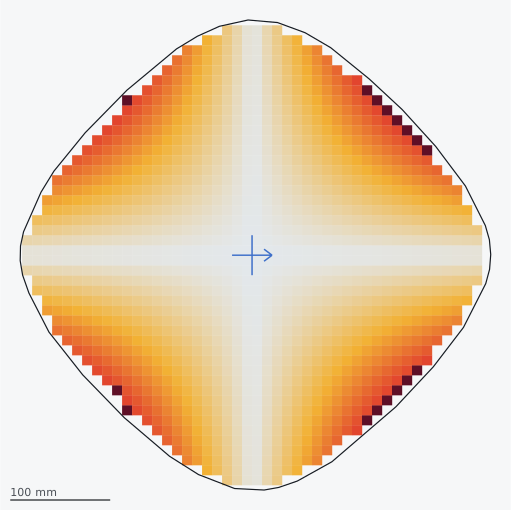
The lobed shape above is the whole argument for draping software in one picture. No flattening tool produces it, because it is not the surface's shape. It is the cloth's.
Open DrapeCut